
In the global footwear manufacturing industry, investment decisions are no longer driven only by machine specifications or production capacity. Today, factory owners and procurement managers are increasingly focused on one critical question: What is the real return on investment (ROI)?
Rising labor costs, increasing material waste, shorter product life cycles, and growing demand for customized footwear are forcing manufacturers to fundamentally rethink traditional production systems. As a result, CNC Cutting Machine for Footwear Industry technology and intelligent automation systems are rapidly replacing manual cutting and conventional die-cutting methods.RUIZHOU, as a professional Intelligent Cutting Machine Supplier, has been widely adopted by footwear factories seeking measurable cost reduction, production flexibility, and faster investment payback.This article provides a deeper breakdown of the real ROI behind intelligent cutting systems and explains why upgrading production equipment is becoming a strategic necessity rather than an optional choice.
The True Cost Behind Traditional Footwear Cutting Operation
Many footwear manufacturers only consider the upfront cost of equipment when evaluating production systems. However, the real cost structure of traditional cutting methods is far more complex and significantly higher over time.In conventional workshops using manual cutting or die-cutting systems, production efficiency depends heavily on labor skill and experience. While this may appear manageable in small-scale production, it becomes a major limitation in modern competitive supply chains.
Hidden cost factors include:
Continuous increase in labor wages and workforce instability
High dependency on skilled operators
Frequent material waste due to manual layout
Rework caused by human error and inconsistent cutting quality
Mold and die development costs for each product variation
Long setup and changeover time between production runs
Limited flexibility for small-batch and multi-style orders
In many factories, labor cost alone accounts for a significant portion of total production expenses. However, the larger issue is not just labor—it is inefficiency across the entire production flow.Material waste, especially in leather and synthetic materials, further increases cost pressure. Even a small percentage of waste directly reduces profit margins at scale.These inefficiencies accumulate into a structural cost burden that limits factory competitiveness.
CNC Cutting Machine for Footwear Industry: A Structural Cost Shift
The introduction of CNC Cutting Machine for Footwear Industry technology fundamentally changes how footwear production costs are structured and controlled.
Unlike traditional cutting methods, CNC systems eliminate the need for physical molds and manual cutting processes. Instead, production is driven by digital data, intelligent nesting algorithms, and automated cutting paths.This shift transforms production from a labor-intensive model into a data-driven manufacturing system.
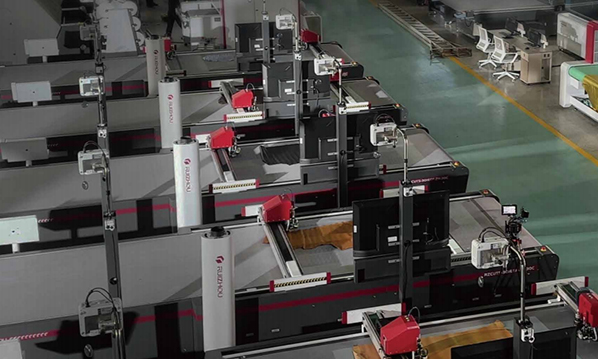
Key cost transformations include:
1.Elimination of mold and die production costs
2.Reduced dependency on manual labor
3.Significant reduction in material waste through intelligent nesting
4.Faster production changeovers without tooling delays
5.Lower defect and rework rates due to digital precision
For many factories, this results in a direct reduction in cost per pair of shoes and a significant improvement in production scalability.More importantly, it allows manufacturers to respond quickly to market demand without incurring additional setup costs, which is critical in today’s fast-changing footwear industry.
Faster Order Response and Market Competitiveness
Among all production cost structures, labor cost reduction is the most immediate and visible source of ROI. Traditional cutting workshops typically require multiple operators for material marking, cutting, and sorting, resulting in high labor dependency and complex workforce management. With intelligent CNC systems, these processes are significantly simplified or even fully automated, reducing reliance on skilled labor, lowering recruitment and training costs, improving production stability, and minimizing the impact of labor fluctuations. In many cases, each production line can reduce multiple operator positions, generating continuous monthly labor cost savings that accumulate over time and continuously increase ROI throughout the equipment lifecycle.
At the same time, faster order response has become a key competitive advantage in the modern footwear industry. Brands and retailers increasingly require shorter lead times and faster sampling cycles, but traditional cutting systems are limited by mold production delays and long setup times. CNC cutting systems enable instant design modifications without production interruption, eliminate the need to wait for physical molds or dies, support more cost-effective small-batch production, and significantly shorten sample development cycles. This flexibility allows factories to accept more orders and respond quickly to market changes, ultimately improving overall revenue potential and market competitiveness.
In addition, material waste reduction is one of the most overlooked yet financially significant factors in footwear manufacturing. Through intelligent nesting and optimized cutting paths, RUIZHOU systems significantly improve material utilization by increasing yield per sheet or leather roll, reducing offcut and scrap waste, and optimizing the use of irregular materials. Unlike labor cost savings, which reduce expenses, material optimization directly increases gross profit without requiring any increase in selling price, making it one of the most powerful and direct drivers of profit improvement in modern footwear production.
How Fast Does Investment Return?
One of the most important questions for factory owners is the investment payback period.While actual ROI depends on production scale, product type, and operational conditions, most manufacturers experience:
Rapid payback through combined labor and material savings
Continuous cost reduction throughout machine lifecycle
Long-term improvement in production efficiency
Unlike consumable-based savings, CNC cutting machines provide ongoing value generation over many years of operation.This transforms the investment from a cost center into a long-term productivity asset.For manufacturers seeking to reduce production costs, improve profitability, and strengthen global competitiveness, adopting CNC cutting technology represents not just an equipment upgrade—but a long-term strategic investment in future manufacturing capability.Company Website: www.ruizhoucnc.com